Powerful inbound marketing examples that actually drive results

There's an old saying in sales: "Nothing happens until somebody sells something." But what happens before the sale? What brings the customer to your door?
Most businesses still operate under an antiquated assumption—that marketing means interruption. Cold calls. Pop-up ads. Direct mail pieces that go straight to the trash.
The shift isn't just about economics. Customer behavior has fundamentally changed. Today's buyers complete most of their purchase journey before ever speaking to a sales representative. They research, compare, and educate themselves long before they're ready to buy. Smart companies have stopped chasing customers and started attracting them instead.
The companies winning today understand a counterintuitive truth: the best way to sell is to stop selling. Instead, they create value first, build trust through expertise, and position themselves as the obvious choice when prospects are ready to buy.
What is inbound marketing?
Inbound marketing attracts customers by creating valuable content and experiences tailored to their needs. Rather than pushing messages onto prospects who don't want them, inbound marketing pulls interested prospects toward your business by solving their problems and answering their questions.
Core components of inbound marketing strategy
Effective inbound marketing operates across four stages: Attract, Convert, Close, and Delight. Each stage requires different tactics and content types, but they work together to create a seamless customer journey.
The Attract stage uses blog content, social media, and SEO to draw prospects to your website. Convert transforms visitors into leads through landing pages, forms, and lead magnets. Close nurtures leads into customers through email sequences and sales enablement content. Delight turns customers into advocates through exceptional service and ongoing value.
What makes this approach powerful is its compounding nature. Unlike outbound marketing where each campaign starts from zero, inbound marketing builds assets that continue generating value over time. A well-optimized blog post can attract prospects for years after publication.
Content marketing examples that attract prospects
Content marketing forms the foundation of successful inbound strategies. But not all content is created equal—the most effective content solves specific problems for defined audiences rather than promoting products or services.
Blog content that drives organic traffic
The key insight behind success is specificity. Instead of writing generic posts about "marketing tips," create detailed guides addressing precise challenges. Post on email subject lines doesn't just suggest "be creative"—it provides 164 specific examples with open rate data.
This approach works because it builds trust before selling. When prospects eventually need marketing software, HubSpot has already established credibility by solving their problems for free. The business impact is measurable: companies with blogs generate 6x more conversions than those without.
Educational resource libraries
Educate prospects who might not understand the value of CRM software, it demonstrates product capabilities without requiring demos, and it creates a community of users who associate learning with the brand. The psychological principle at work is reciprocity—when you provide genuine value upfront, prospects feel compelled to return the favor through their business.
The resource library approach is particularly effective for complex B2B sales where education drives purchase decisions. According to Gartner and Forrester–aligned research on B2B demand generation, the majority of B2B marketing teams now rely on content marketing as a core channel, and the most effective organizations focus on educational, buyer‑oriented content rather than purely promotional messaging
Video content and webinar series
Video content has become increasingly important for inbound marketing, with many marketers reporting that video drives more traffic to their websites.
Instead of traditional product advertisements, create detailed video reviews comparing different mattress types, explaining sleep positions, and addressing common concerns like heat retention or motion transfer.
The effectiveness comes from matching content format to user intent. People researching major purchases often prefer video content because it provides more information density than text and feels more trustworthy than written reviews. Video landing pages see 86% higher conversion rates than text-only pages.
Social media inbound marketing examples
Social media inbound marketing goes beyond posting promotional content. The most successful companies use social platforms to build communities, provide customer service, and gather insights about their audience's needs and preferences.
Community building and engagement
Buffer exemplifies social media inbound marketing by sharing insights about social media management while building a community around transparency and authentic communication. They publish their revenue numbers, employee salaries, and business challenges openly.
This transparency creates trust and positions Buffer as a thought leader in social media marketing. When prospects need social media management tools, they think of Buffer first because the company has already demonstrated expertise and authenticity. The approach works because it addresses the fundamental challenge of social media marketing: cutting through noise with genuine value.
Engagement metrics support this strategy—posts that educate or entertain receive significantly higher engagement than promotional content. Buffer's educational posts about posting times or hashtag strategies regularly receive thousands of shares and comments.
User-generated content campaigns
Airbnb transformed travel marketing by encouraging hosts and guests to share authentic experiences rather than creating traditional advertisements. Their Instagram features real photos from real travelers, not stock images of perfect hotel rooms.
This user-generated content strategy works because it provides social proof while reducing content creation costs. Potential travelers see authentic experiences from people like themselves, which builds trust more effectively than professional marketing materials. Research shows that user-generated content increases booking rates and customer loyalty significantly.
The psychological principle behind this success is social proof—people trust recommendations from peers more than brand messages. When Airbnb hosts share photos of happy guests, it creates authentic marketing that money can't buy.
Social listening and customer service
Many companies treat social media as a broadcasting channel, but smart brands use it for listening. HelloFresh monitors social media conversations to identify recipe requests, dietary concerns, and service issues before they become major problems.
This proactive approach turns potential complaints into positive experiences. When customers post about missing ingredients or recipe confusion, HelloFresh responds quickly with solutions and often shares the feedback with their product development team. This responsiveness builds loyalty and demonstrates that the company values customer input.
The business impact extends beyond customer service. Social listening provides market research insights that inform product development and content creation. Companies using social listening effectively see improved customer satisfaction scores and reduced churn rates.
SEO and organic search examples
Search engine optimization remains one of the most effective inbound marketing channels because it captures prospects with high purchase intent. The key is understanding what your prospects actually search for and creating content that matches their intent at different stages of the buying journey.
Keyword-optimized content strategies
Warby Parker built their online presence by targeting specific search queries related to eyewear problems: "how to measure pupillary distance," "what face shape suits round glasses," or "how to adjust glasses at home." These searches indicate clear intent but don't immediately suggest product promotion.

Source: Warby Parker ads
By creating detailed guides answering these questions, Warby Parker attracts prospects early in their research process. The content builds trust by providing value without immediate sales pressure, then guides readers toward their virtual try-on tool when they're ready to consider frames.
This strategy works because it aligns content with search intent. People searching for "how to measure pupillary distance" aren't ready to buy glasses yet, but they will be eventually. By providing helpful information at this stage, Warby Parker becomes the trusted resource prospects remember when they're ready to purchase.
Local SEO for service businesses
Local service businesses can achieve remarkable results through location-specific content strategies. A plumbing company in Austin might create content about "common plumbing problems in Austin homes" or "how Austin's hard water affects your pipes."
This approach serves multiple SEO purposes: it targets local keywords with lower competition, it demonstrates local expertise, and it addresses region-specific concerns that national competitors can't match. Local searches often have higher commercial intent than general searches, making them particularly valuable for service businesses.
The effectiveness comes from relevance and specificity. Someone searching for "Austin plumber" is likely ready to hire someone soon, but someone searching for "hard water problems Austin" might be in earlier research stages. By targeting both types of searches, local businesses capture prospects throughout their decision process.
Technical SEO implementation
Technical SEO provides the foundation that makes content marketing effective. Companies like Zappos invested heavily in site speed, mobile optimization, and structured data to ensure their product pages rank well for commercial searches.
Page speed particularly impacts conversion rates—every second of load time can reduce conversions by 7%. Mobile optimization is equally critical since mobile searches now account for the majority of Google queries.
The business impact of technical SEO is often underestimated. Poor technical implementation can make excellent content invisible in search results, while strong technical foundations can help mediocre content rank well. Companies that invest in technical SEO alongside content creation see substantially better organic traffic growth.
Email marketing and lead nurturing examples
Email marketing and lead nurturing remains one of the highest ROI marketing channels when executed properly. The key is providing value in every message rather than treating email as a sales channel. The most successful companies use email to educate, inform, and build relationships over time.
Welcome series and onboarding campaigns
Slack's onboarding email series demonstrates how to nurture new users without overwhelming them with features. Instead of sending a single welcome email with every possible feature, they spread education across multiple messages that arrive based on user behavior.
New users receive emails about basic messaging, then file sharing, then advanced features like workflow automation—but only after they've demonstrated comfort with previous features. This behavioral triggering ensures users receive relevant information when they're ready for it.
The effectiveness comes from progressive disclosure and timing. Rather than overwhelming new users with everything at once, Slack guides them through a logical learning progression. This approach reduces churn and increases feature adoption rates significantly.
Educational newsletter programs
Morning Brew built a media business around educational email content that makes business news accessible and entertaining. Their daily newsletter explains complex business concepts in simple terms while maintaining a conversational tone that feels personal rather than corporate.
The success comes from consistency and value. Subscribers know they'll receive useful information every day without sales pitches or promotional content. This trust building creates an audience that actively opens emails instead of ignoring them.
Educational newsletters work because they provide ongoing value rather than immediate sales pressure. Subscribers develop reading habits around valuable content, which creates regular touchpoints for brand building. When subscribers eventually need related services, the newsletter publisher has already established credibility and trust.
Behavioral trigger campaigns
Behavioral email campaigns respond to specific user actions rather than following predetermined schedules. An e-commerce company might send different messages to users who abandon shopping carts versus those who browse without adding items.
Cart abandonment emails work particularly well because they address immediate intent. Someone who adds items to their cart has demonstrated purchase interest but may need additional information or incentive to complete the transaction. Well-timed abandonment emails can recover 30% or more of lost sales.
The key is relevance and timing. Behavioral triggers allow companies to send highly relevant messages at optimal moments rather than generic broadcasts that may or may not match subscriber needs. This personalization increases open rates, click-through rates, and conversion rates substantially.
Lead generation and conversion examples
Converting website visitors into leads requires offering something valuable in exchange for contact information. The most effective lead magnets solve specific problems for defined audiences rather than offering generic resources that appeal to everyone.
Lead magnets and gated content
Effective lead generation provides immediate value while capturing contact information. Users enter their website URL and email address to receive a detailed report about their site's performance, SEO, and mobile optimization.
This approach works because it provides instant gratification while demonstrating product value. Users receive useful information immediately, and gains qualified leads who have demonstrated interest in website optimization. The tool also generates talking points for sales conversations since the grader report identifies specific improvement opportunities.
The psychology behind effective lead magnets is reciprocity combined with immediate value. When companies provide genuine help upfront, prospects feel obligated to consider their services later. The key is ensuring the lead magnet truly solves problems rather than just collecting contact information.
Landing page optimization
Unbounce built their business around landing page optimization, and their own landing pages demonstrate best practices. They use clear headlines that communicate value propositions immediately, social proof in the form of customer logos and testimonials, and single-focused calls to action that minimize decision paralysis.
Their landing pages typically focus on one primary benefit rather than listing every possible feature. The headline might read "Build Landing Pages That Convert" instead of "Complete Digital Marketing Platform with Landing Pages, A/B Testing, Analytics, and More." This focus reduces cognitive load and increases conversion rates.
Effective landing pages remove friction and distractions while emphasizing benefits over features. They answer the prospect's immediate question: "What's in this for me?" The most successful pages communicate this answer within seconds of visitor arrival.
Free tool and calculator strategies
WE R CBD grew their email list by 5,000 subscribers in three months using an interactive discount wheel that offers 5-10% savings in exchange for email addresses. This gamification approach makes lead generation feel fun rather than transactional.
The wheel strategy works because it combines immediate value (discount) with entertainment (spinning the wheel). Users engage with the tool because it's enjoyable, and they provide contact information because they receive immediate benefit. This positive first impression sets the stage for ongoing email relationship building.
Free tools and calculators work particularly well for businesses where prospects need to perform calculations or assessments before purchasing. A mortgage company might offer affordability calculators, or a marketing agency might provide ROI calculators. These tools provide value while qualifying prospects and generating conversation starters for sales teams.
B2C inbound marketing examples
B2C inbound marketing often focuses on entertainment and lifestyle content rather than pure education, though the underlying principles remain the same: provide value before asking for anything in return.
E-commerce and retail examples
Sephora built their beauty community through educational content about makeup techniques, skincare routines, and product selection. Their YouTube channel, blog, and in-store classes teach customers how to use products effectively rather than just promoting specific items.
This educational approach builds customer confidence and loyalty. Customers who feel knowledgeable about beauty techniques are more likely to experiment with new products and trust Sephora's recommendations. The company sees higher average order values and repeat purchase rates from customers who engage with educational content.
The strategy works because it addresses customer anxiety about making wrong choices. Beauty products require application knowledge to be effective, and customers who don't know how to use products properly become dissatisfied customers who don't return.
Lifestyle and consumer brands
Red Bull created an entire media empire around extreme sports and adventure content that appeals to their target audience without directly promoting energy drinks. Their content strategy focuses on lifestyle and values rather than product features.

Source: Youtube
This approach builds emotional connections that transcend product preferences. Red Bull customers don't just buy energy drinks—they buy into a lifestyle and mindset that Red Bull represents through their content. This emotional loyalty commands premium pricing and reduces price sensitivity.
Lifestyle content works for brands where emotional factors influence purchase decisions more than rational evaluation. Customers buy Red Bull because of how it makes them feel, not because of specific functional benefits compared to competitors.
Service-based business examples
Local fitness studios and personal trainers increasingly use social media and blog content to attract clients through workout tips, nutrition advice, and motivational content. This approach builds trust and demonstrates expertise before prospects visit the gym.
Fitness content performs well on social media because it's visual, shareable, and provides immediate value. Followers can try workout tips immediately and see results, which builds trust in the trainer's expertise. This trust makes prospects more likely to invest in personal training services.
Service-based businesses succeed with inbound marketing when they provide samples of their expertise rather than just describing their services. Prospects want evidence that the service provider can deliver results before making financial commitments.
How to implement these inbound marketing examples
Starting with inbound marketing can feel overwhelming given the range of tactics and channels available. The most successful implementations begin with one or two channels and expand gradually based on results and available resources.
Getting started with inbound marketing
Begin by identifying your ideal customer's biggest challenges and questions. Use keyword research tools, customer interviews, and sales team insights to understand what prospects search for and what problems they need solved.
Create a content calendar addressing these topics with various content types: blog posts for detailed explanations, videos for complex demonstrations, and downloadable guides for comprehensive coverage. Focus on providing genuine value rather than promoting products or services.
Set up basic tracking to measure content performance and lead generation. Even simple Google Analytics goals can provide insights about which content resonates with your audience and drives desired actions.
Budget and resource allocation
Inbound marketing requires consistent content creation and optimization rather than large upfront investments. According to Forrester’s B2B marketing‑budget benchmarking research and McKinsey’s work on marketing‑spend optimization, the most effective B2B marketing teams increasingly prioritize investment in high‑value, owned‑content programs and digital channels, while rebalancing spend away from low‑impact, purely promotional activities..
Content creation costs vary significantly based on quality and complexity. Blog posts might cost $200-500 each when outsourced, while comprehensive guides or videos can cost several thousand dollars. The key is starting with sustainable content production rather than trying to create everything immediately.
Distribution and promotion often require more budget than content creation itself. Even excellent content needs promotion through social media advertising, email marketing, and SEO optimization to reach target audiences effectively.
Common mistakes to avoid
The biggest mistake is creating content without understanding audience needs. Generic content that doesn't address specific problems or answer real questions fails to attract qualified prospects or build trust with potential customers.
Another common error is inconsistent publishing schedules. Inbound marketing works through compound effects over time, but these effects require consistent content creation and engagement. Sporadic publishing reduces momentum and makes it difficult to build audience expectations.
Many companies also make the mistake of focusing only on top-of-funnel content without creating material for prospects ready to purchase. This creates a gap where interested prospects can't find the information they need to make buying decisions.
Finally, inadequate measurement and optimization prevent companies from improving their results over time. Without proper tracking, it's impossible to identify which tactics work and which need improvement.
Transform your inbound marketing with Tenet's AI agent
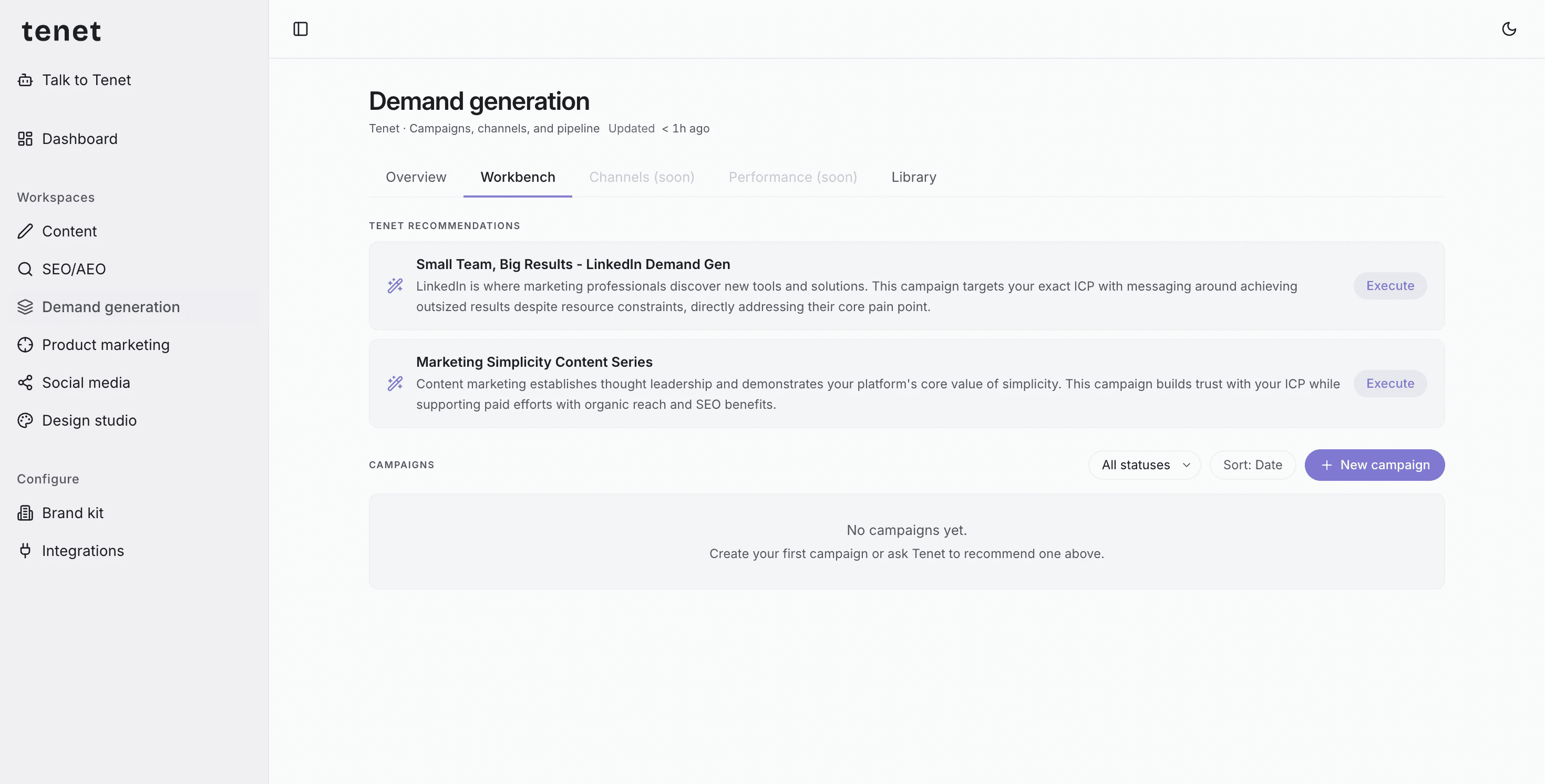
Caption: Demand gen campaign example from Tenet
Implementing these inbound marketing examples requires coordinating multiple moving parts: content creation, SEO optimization, lead generation, email nurturing, and performance tracking. For growing companies, managing this complexity across multiple tools while maintaining consistency can become overwhelming.
Tenet eliminates this challenge by providing a comprehensive AI marketing platform designed specifically for businesses ready to scale. Instead of juggling 8-12 different marketing tools, you get strategy-backed content creation, advanced SEO optimization, integrated lead generation, and automated nurturing campaigns—all in one simple platform.
Upload your existing content and Tenet learns your brand voice in minutes. Then generate SEO-optimized blog posts, email sequences, social campaigns, and lead magnets that convert—all on-brand, fact-checked, and scored for quality. Small teams can now execute what used to require entire marketing departments.
Marketing made simple. Small teams, big impact.
Ready to transform your marketing from scattered tactics into a revenue-generating system? Discover how Tenet's AI platform can help you implement these proven inbound marketing strategies without the complexity.
The companies winning with inbound marketing aren't necessarily the ones with the biggest budgets—they're the ones with the most consistent execution. These 15 examples prove that providing genuine value, building trust through expertise, and nurturing relationships over time creates sustainable competitive advantages that outlast any individual campaign or tactic.
The question isn't whether inbound marketing works—the data makes that clear. The question is whether you'll implement these strategies before your competitors do. Start with one or two tactics that align with your current resources, measure the results, and expand gradually based on what works for your specific audience and business model.
Frequently asked questions
What is an example of inbound and outbound marketing?
Inbound marketing example: A software company creates a detailed guide titled "How to Choose Project Management Software for Remote Teams" that prospects find through Google searches. The guide educates readers about features to consider, common pitfalls, and evaluation criteria without promoting any specific product. Interested readers can download the guide in exchange for their email address, then receive a nurturing email series with additional tips.
Outbound marketing example: The same software company purchases a list of email addresses from remote teams and sends unsolicited emails promoting a free trial of their project management tool. They also run display ads on websites that remote workers visit, interrupting their browsing experience with promotional messages.
The key difference is that inbound attracts people already looking for solutions, while outbound interrupts people who haven't expressed interest. Inbound generates 54% more leads at 62% lower cost because it matches content to existing demand rather than creating artificial demand through interruption.
What is the 3-3-3 rule in sales?
The 3-3-3 rule suggests that prospects typically interact with your company at three different times, through three different channels, over three weeks before making purchase decisions. This rule highlights why inbound marketing's multi-touch approach is so effective.
For example, a prospect might first discover your company through a blog post found via Google search, then see your social media content shared by a colleague, and finally attend your webinar before requesting a sales conversation. Each touchpoint builds familiarity and trust without requiring direct sales pressure.
This rule explains why nurtured inbound leads make 47-50% larger purchases than non-nurtured leads. Multiple positive interactions create stronger relationships and better qualified prospects who are more likely to buy and buy more when they're ready.
What is inbound marketing?
Inbound marketing attracts customers by creating valuable content and experiences tailored to their needs rather than interrupting them with unwanted promotional messages. It works by matching content to different stages of the buyer's journey: brand awareness, consideration, and decision.
At the awareness stage, prospects realize they have a problem but don't know how to solve it. Inbound content at this stage educates about the problem and potential solutions without promoting specific products. At the consideration stage, prospects evaluate different approaches to solving their problem. Content here compares different solution types and helps prospects understand what to look for.
At the decision stage, prospects are ready to choose a specific vendor. Content here demonstrates expertise, provides social proof through case studies, and addresses specific concerns about your solution. This educational approach builds trust and positions your company as the obvious choice when prospects are ready to buy.
What are the types of inbound marketing?
Inbound marketing encompasses several interconnected strategies that work together to attract, convert, and delight customers:
Content Marketing creates valuable blog posts, videos, guides, and resources that prospects find through search engines and social sharing. This forms the foundation of most inbound strategies.
Search Engine Optimization (SEO) ensures content appears in search results when prospects look for solutions to their problems. This includes keyword optimization, technical SEO, and link building.
Social Media Marketing builds communities around shared interests and values while providing customer service and gathering market insights. Successful social media inbound focuses on engagement and value rather than promotion.
Email Marketing nurtures prospects through educational sequences that build relationships over time. This includes welcome series, behavioral triggers, and ongoing newsletters that provide value.
Lead Generation converts website visitors into contacts through valuable offers like guides, tools, or webinars in exchange for contact information.
Marketing Automation delivers personalized experiences based on prospect behavior and interests, ensuring relevant content reaches the right people at optimal times.
How long does it take to see results from inbound marketing?
Most companies begin seeing initial results within 3-6 months, with significant momentum building after 12-18 months of consistent effort. However, the timeline varies significantly based on competition level, content quality, and implementation consistency.
Early results typically include increased organic traffic and social media engagement as content begins ranking in search engines and attracting shares. Lead generation usually improves within 6-9 months as content assets accumulate and SEO efforts gain traction.
Revenue impact often takes 12-18 months because inbound marketing works through relationship building rather than immediate sales pressure. However, companies with blogs achieve positive ROI from inbound marketing at much higher rates than those without consistent content creation.
The key is understanding that inbound marketing creates compounding returns over time. A blog post published today might generate leads for years, making the long-term ROI substantially higher than short-term campaigns.
What's the difference between inbound marketing and content marketing?
Content marketing is a subset of inbound marketing rather than a separate strategy. Content marketing focuses specifically on creating and distributing valuable content to attract and retain audiences. Inbound marketing uses content marketing as one component of a broader strategy that includes SEO, social media, email marketing, and lead generation.
Think of content marketing as the fuel and inbound marketing as the engine. Content provides the value that attracts prospects, but inbound marketing includes the systems and processes that convert prospects into customers and customers into advocates.
Successful inbound marketing requires content, but it also requires distribution strategies, conversion optimization, lead nurturing workflows, and performance measurement. Companies focusing only on content creation without these supporting elements often struggle to generate meaningful business results.
How do you measure inbound marketing ROI?
Measuring inbound marketing ROI requires tracking the complete customer journey from first interaction through purchase and beyond. The basic calculation is (Revenue Generated - Marketing Investment) / Marketing Investment × 100.
However, inbound marketing's long-term nature makes attribution challenging. Prospects might read blog posts for months before converting, making it difficult to assign revenue to specific content pieces. The solution is using marketing automation tools that track all interactions and provide multi-touch attribution.
Key metrics include cost per lead, lead-to-customer conversion rates, average deal size, and customer lifetime value. Companies tracking these comprehensive metrics can demonstrate that inbound leads cost 61% less than outbound leads while generating larger purchase amounts.
The most sophisticated measurement includes leading indicators like organic traffic growth and content engagement alongside lagging indicators like revenue and customer acquisition costs.
Can small businesses succeed with inbound marketing?
Small businesses often see faster results from inbound marketing than larger companies because they can move quickly, create personal relationships with prospects, and focus intensely on specific niches. The key advantages include lower costs compared to traditional advertising, ability to compete based on expertise rather than budget, and building valuable assets over time.
Guy Kawasaki captures this perfectly: "If you have more money than brains, you should focus on outbound marketing. If you have more brains than money, you should focus on inbound marketing."
Small businesses succeed by focusing on specific audience segments and becoming the go-to resource for particular problems rather than trying to appeal to everyone. A local accounting firm might create content specifically about tax issues for small restaurants, building authority in a specific niche rather than competing with national firms on generic topics.
The challenge for small businesses is consistent content creation with limited resources. However, even modest content creation efforts can generate significant results when properly targeted and optimized.
See other articles

A practical guide to account-based marketing that works
Complete guide to account-based marketing (ABM) with proven strategies, implementation tactics, and real-world examples. Learn ROI-driven ABM for B2B growth.

Why your marketing pipeline isn't converting
Master marketing pipeline management with proven strategies, essential stages, and best practices. Learn to build, optimize, and measure pipelines that drive revenue growth in 2026.

AndHumanity sees the future of lean marketing teams with Tenet
AndHumanity co-founder Matthew Tsang explains how Tenet transformed their marketing from survival mode to a strategic engine. One operator now runs what used to require a full department.